CHARLESTON — A public feud between U.S. Sen. Jim Justice and Gov. Patrick Morrisey over the future of The Greenbrier has escalated into a broader dispute over the state’s economic direction, as speculation grows that Justice could seek a return to the governor’s mansion in 2028.
The latest exchange began after Kennedy Lewis Investment Management, a New York-based private credit and opportunistic asset management firm, completed a $500 million financing agreement that made it the majority owner and controlling interest holder of The Greenbrier. The agreement provided $300 million to address debt tied to the resort and another $200 million for upgrades.
Morrisey welcomed Kennedy Lewis to West Virginia and said he would work to protect Greenbrier employees during the transition.
“West Virginia’s iconic Greenbrier Hotel is now under the majority ownership and controlling interest of Kennedy Lewis, a New York-based private credit and opportunistic asset firm,” Morrisey said. “With Kennedy Lewis now officially controlling the resort, I welcome them to West Virginia. I also want everyone to know – especially those in Greenbrier County – that I will do everything in my power to protect this historic West Virginia jewel and its employees.”
He also expressed hope that the new ownership would help restore the historic resort to its former glory:
“I have asked the Lottery Commission to take all necessary steps to prevent the loss of Greenbrier employees during this transition of ownership,” Morrisey continued, “I’m hopeful that Kennedy Lewis and the entire Greenbrier team will help restore the beauty of the resort to its former glory.”
Justice, whose family acquired The Greenbrier in 2009 after it entered bankruptcy, took offense to the Governor’s remarks.
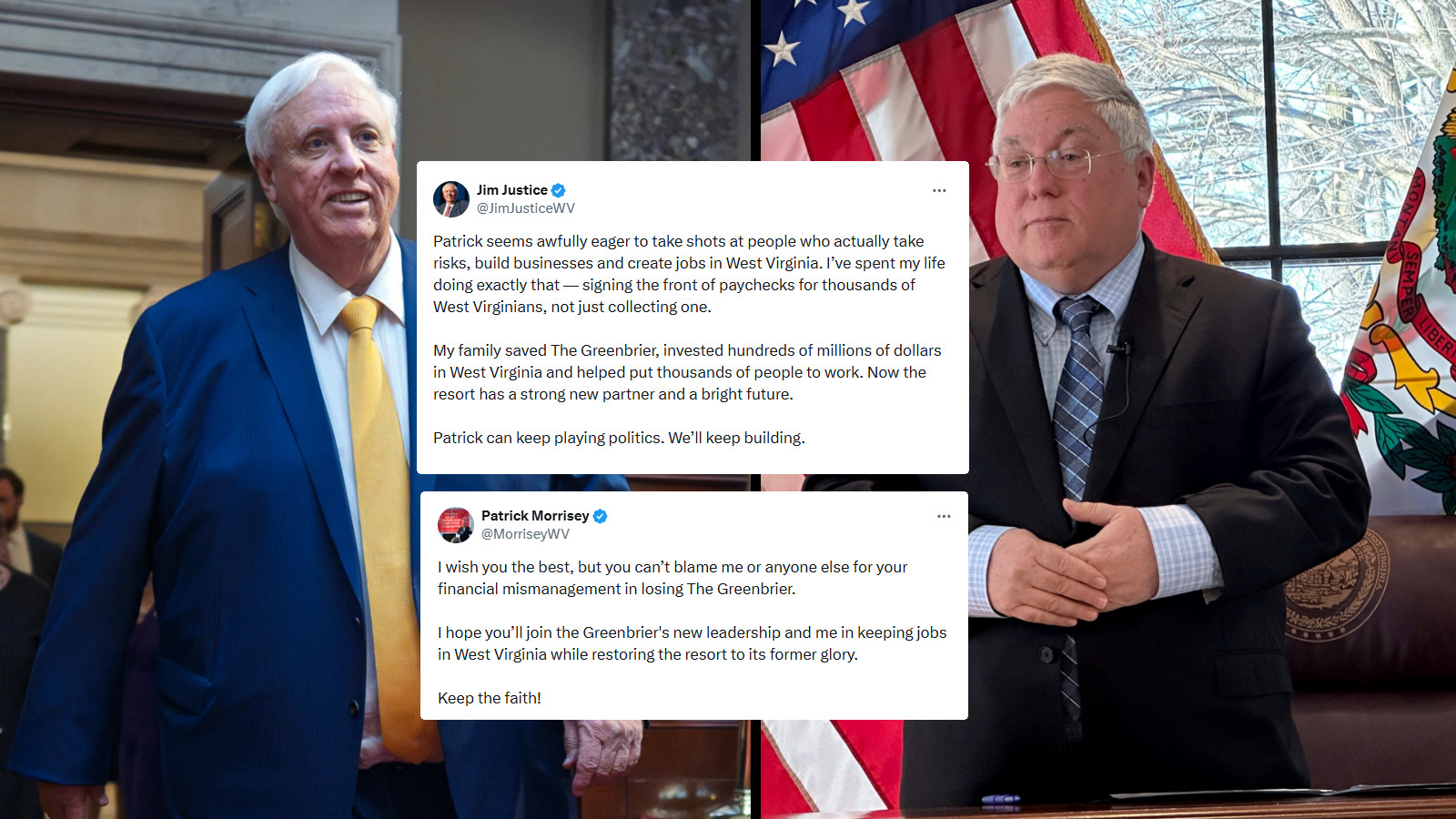
“Patrick seems awfully eager to take shots at people who actually take risks, build businesses and create jobs in West Virginia,” Justice said in a social media post. “I’ve spent my life doing exactly that — signing the front of paychecks for thousands of West Virginians, not just collecting one.”
Justice defended his family’s record at The Greenbrier, saying it had invested hundreds of millions of dollars in West Virginia and helped put thousands of people to work.
He said the resort now has “a strong new partner and a bright future” and added, “Patrick can keep playing politics. We’ll keep building.”
Morrisey responded Wednesday, directly challenging Justice’s characterization of the dispute.
“I wish you the best, but you can’t blame me or anyone else for your financial mismanagement in losing The Greenbrier,” Morrisey said.
He urged Justice to work with the resort’s new leadership and his administration to preserve jobs and restore the property.
I wish you the best, but you can’t blame me or anyone else for your financial mismanagement in losing The Greenbrier.
I hope you’ll join the Greenbrier’s new leadership and me in keeping jobs in West Virginia while restoring the resort to its former glory.
Keep the faith! https://t.co/cpzPc0oxPM
— Patrick Morrisey (@MorriseyWV) August 26, 2026
The dispute comes as the two Republicans have increasingly represented different approaches to economic development. Morrisey has emphasized policies intended to make West Virginia more attractive to businesses through a more favorable regulatory, tax and business climate, arguing that economic growth should come from private investment rather than large taxpayer incentives. His administration has also placed a major emphasis on repairing the state’s aging water and wastewater infrastructure.
Justice, during his two terms as governor, pursued a more incentive-driven economic development strategy, using hundreds of millions of dollars in state and other public resources to help recruit companies to West Virginia. Those efforts included incentives and subsidies aimed at persuading out-of-state companies to establish or expand operations in the state, with the expectation that new jobs, economic activity and eventually additional tax revenue would offset the public investment.
Several of those projects later faced financial difficulties, delays or questions about whether promised economic benefits would materialize. The state’s use of taxpayer money to recruit companies also became politically controversial, particularly in southern West Virginia, where critics argued that government resources devoted to economic development incentives and highly publicized ribbon-cutting ceremonies could instead have been used to address longstanding water and sewer infrastructure problems.
Morrisey has sought to distinguish his administration from that approach by making water and wastewater infrastructure a central part of his economic agenda. His administration has announced major investments aimed at upgrading sewage and water systems, arguing that reliable infrastructure is essential to attracting businesses and supporting long-term economic growth.
The disagreement over The Greenbrier therefore reflects more than a personal dispute between two prominent West Virginia Republicans. It also highlights a fundamental disagreement over how the state should pursue economic development, through direct taxpayer incentives to individual companies or by creating conditions and infrastructure that allow private businesses to invest without relying as heavily on government subsidies.
Justice’s increasingly pointed criticism of Morrisey also comes amid speculation about his political future. Justice, who served as governor from 2017 through 2024 before winning election to the U.S. Senate, has not announced a campaign for governor in 2028. But his continued involvement in West Virginia politics and increasingly public criticism of Morrisey have fueled speculation that he could seek the office again.
The Greenbrier dispute unfolded against the backdrop of a months-long legal and financial battle surrounding the resort. White Sulphur Springs Holdings, which acquired $300 million of Justice family debt tied to The Greenbrier, filed a receivership lawsuit alleging waste, fraud and abuse under the family’s management. The Justice family disputed the allegations. After the Kennedy Lewis agreement closed, the receivership case was dismissed by Judge Frank Volk.
For now, Kennedy Lewis holds majority control of the historic resort, while Justice and Morrisey remain on opposite sides of a growing debate over the state’s economic future. The dispute could take on additional political significance if Justice ultimately decides to pursue another term as governor in 2028.