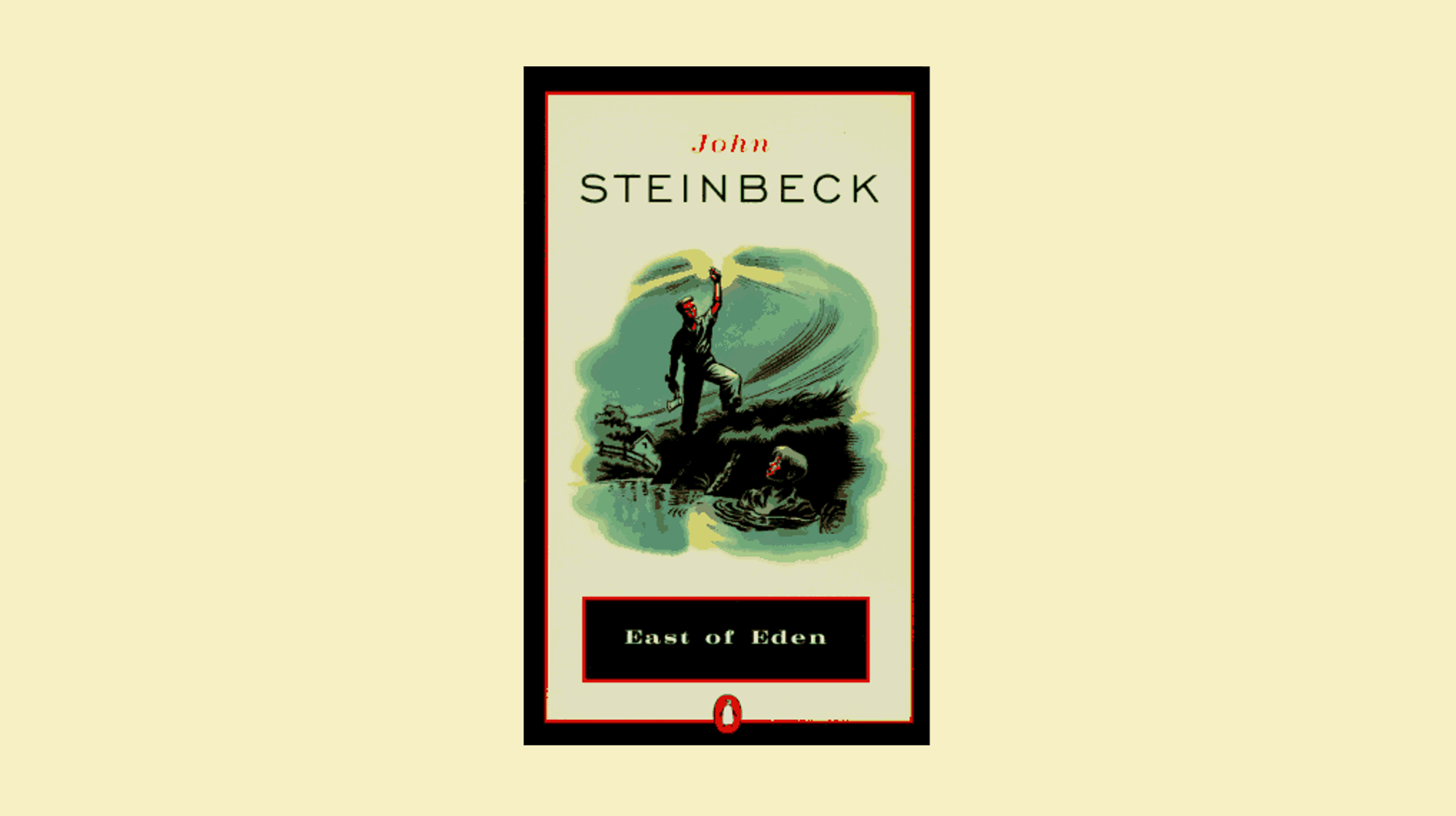

Published in 1952, John Steinbeck’s East of Eden is a bold, sprawling novel that stretches across generations, landscapes, and moral questions. Set in California’s Salinas Valley, the story weaves together two families—the Trasks and the Hamiltons—whose lives mirror the biblical tale of Cain and Abel. But more than a retelling of that story, East of Eden is a deep exploration of the human soul, and the eternal struggle between good and evil.
Steinbeck, who called this his “magnum opus,” creates characters that are flawed, complicated, and deeply human. At the heart of the novel is the idea of “timshel,” a Hebrew word meaning “thou mayest.” This concept suggests that individuals are not doomed by their past or by fate; instead, they have the power to choose their path. It’s this theme of moral choice that makes East of Eden feel both timeless and personal.
The novel covers multiple generations, but the emotional core lies in the relationship between Adam Trask and his two sons, Aron and Cal. Their rivalry reflects the same pain and jealousy seen in the original story of Cain and Abel. Yet, Steinbeck gives his characters a chance to grow beyond their biblical counterparts. Cal, especially, is written with great complexity—a young man desperate to be good, but constantly tempted by darker instincts.
One of the most memorable characters is Cathy Ames, a woman so manipulative and cruel that she almost feels inhuman. And yet, Steinbeck doesn’t simply make her a villain. Instead, he presents her as someone hollowed out by her own choices, challenging readers to question whether evil is born or made.
Steinbeck’s writing is rich and lyrical, full of sweeping descriptions of the Salinas Valley and sharp insights into human nature. At times, the novel feels like a meditation, slowing down to consider life’s big questions. But it never loses its storytelling power, and the emotional weight builds steadily as generations repeat—or resist—past mistakes.
East of Eden is not a quick or easy read, but it’s a powerful one. It asks readers to look inside themselves and consider what it means to be good, and whether we can escape the cycles we inherit. In an age when moral clarity is often in short supply, Steinbeck’s novel reminds us that the ability to choose—to act with compassion or cruelty—is what defines us as human.
More than seventy years after its publication, East of Eden still speaks to the heart of what it means to live with conscience and courage. It remains one of the most ambitious and moving works in American literature.