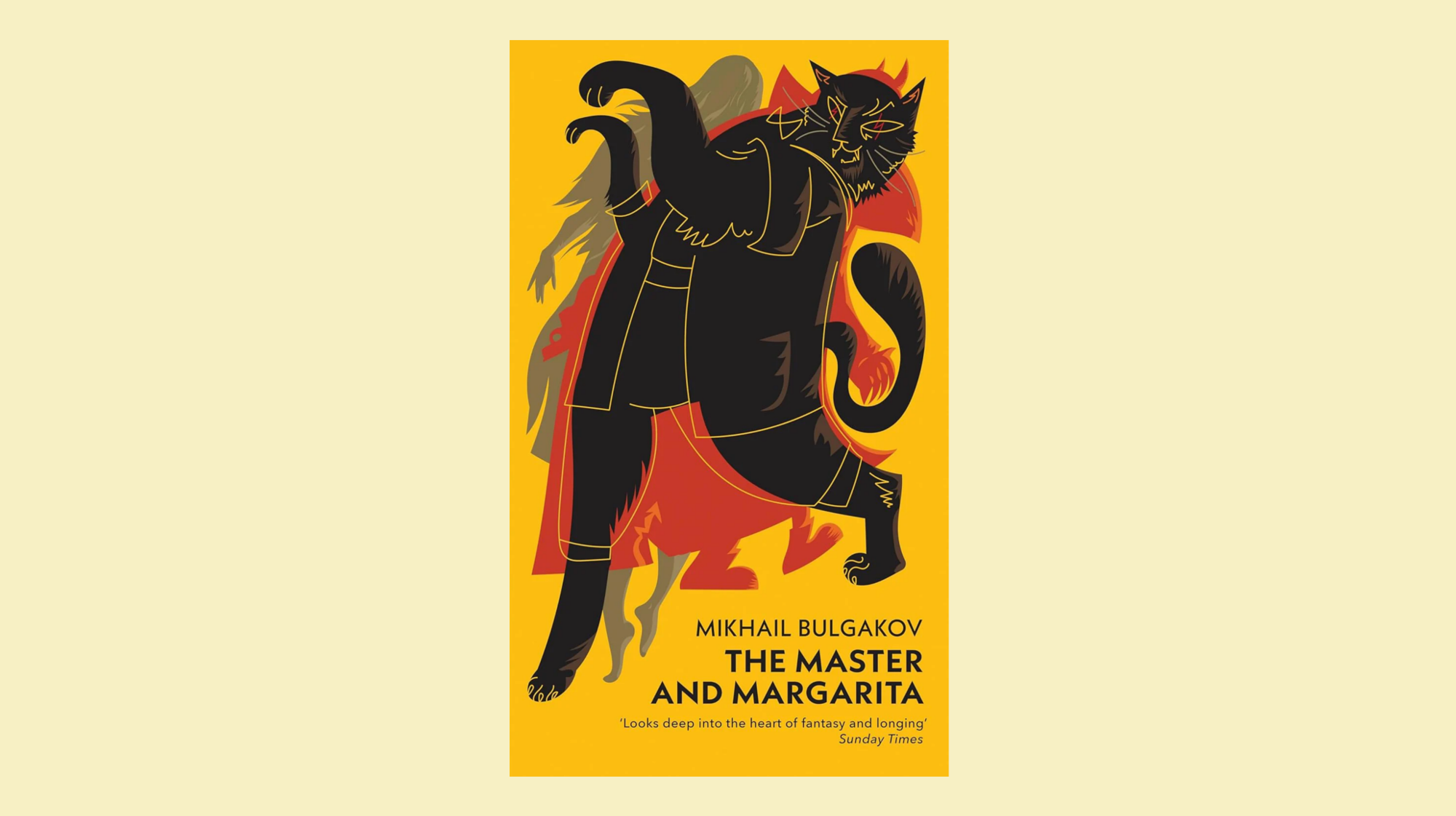

It begins with a conversation in a Moscow park—two men debating the existence of God. One is a poet, the other a literary bureaucrat. And the third? The Devil, of course. In Mikhail Bulgakov’s The Master and Margarita, first published posthumously in 1967 after years of Soviet censorship, the Devil arrives in Stalinist Moscow with a talking cat, a murderous sidekick, and a plan to expose the hypocrisies of a society that has tried to stamp out the soul.
The result is one of the strangest, boldest, and most darkly comic novels of the 20th century: a literary Russian doll of satire, romance, political critique, and metaphysical inquiry. The Master and Margarita does not ask to be understood so much as experienced. It is less a novel in the traditional sense than a raucous theological opera—equal parts Faust, Gogol, and Monty Python.
At the heart of the novel are two stories: one, the Devil’s week-long visit to Moscow, during which the city is turned upside down by black magic, public humiliation, and inexplicable disappearances; and two, a quiet, reverent retelling of Pontius Pilate’s encounter with Yeshua Ha-Notsri (Jesus of Nazareth). Threading through both is the love story of the Master, a tormented author imprisoned for writing a novel about Christ, and Margarita, his fiercely devoted lover who makes a literal deal with the Devil to be reunited with him.
To say the plot is surreal is an understatement. People vanish mid-sentence, witches fly over the city, cats fire pistols and sip vodka, and Satan throws a grand ball for the damned. But beneath the farce lies a solemn meditation on spiritual freedom, artistic truth, and the price of moral compromise. In Stalin’s Russia, where literature was weaponized and writers silenced, Bulgakov’s fantastical satire was a courageous act of defiance—hidden in plain sight.
What makes the novel endure, however, is not just its politics, but its profound humanity. The Master is broken by fear and repression, but Margarita is not. Her descent into the demonic realm is not a fall but a rescue mission. She is the novel’s moral compass and emotional engine—compassionate, resolute, unafraid. Through her, Bulgakov argues that love is not only redemptive, but revolutionary.
Bulgakov’s prose—vividly translated into English by Michael Glenny and later by Richard Pevear and Larissa Volokhonsky—is agile and mischievous, slipping between slapstick and lyricism with ease. His Moscow is both grotesque and gleaming, a city where the absurd is the everyday. Yet through it all, he maintains a novelist’s discipline: his dual narratives braid together with remarkable symmetry, and his themes—truth, cowardice, belief—ring out clearly through the chaos.
To read The Master and Margarita today is to encounter a novel that feels simultaneously ancient and modern, sacred and profane. It satirizes bureaucracy, mocks official atheism, defends the artist, and insists—against all odds—that the soul cannot be legislated.
At its core, The Master and Margarita is a veiled, audacious critique of Soviet communism—disguised in fantasy, but burning with truth. Bulgakov paints Stalinist Moscow as a city stripped of moral compass, where fear and conformity have replaced faith and imagination. The bureaucrats who run the literary establishment are pompous, cynical, and easily undone by the Devil’s tricks—not because he is evil, but because they are hollow. In their desperate attempts to control art, language, and even belief itself, Bulgakov shows how the communist regime has reduced human beings to absurd caricatures, divorced from meaning. Yet instead of didactic condemnation, he uses satire and the supernatural to expose the moral and spiritual vacuum at the heart of Soviet life, revealing a world where official atheism reigns but evil is no less real—and far more mundane. Through the novel’s chaos, Bulgakov mounts not just a political protest, but a spiritual one, reclaiming the individual conscience from the machinery of the state.
Bulgakov once said that manuscripts don’t burn. In The Master and Margarita, that phrase becomes prophecy. The novel itself, smuggled out in secret, rewritten from memory, and published decades after its conception, is a triumph not just of literature but of endurance. It reminds us that even in the darkest of regimes, art can still be dangerous—and necessary.
This is no ordinary book. It is a conjuring. A protest. A love letter. And it still leaves ash on your fingers.