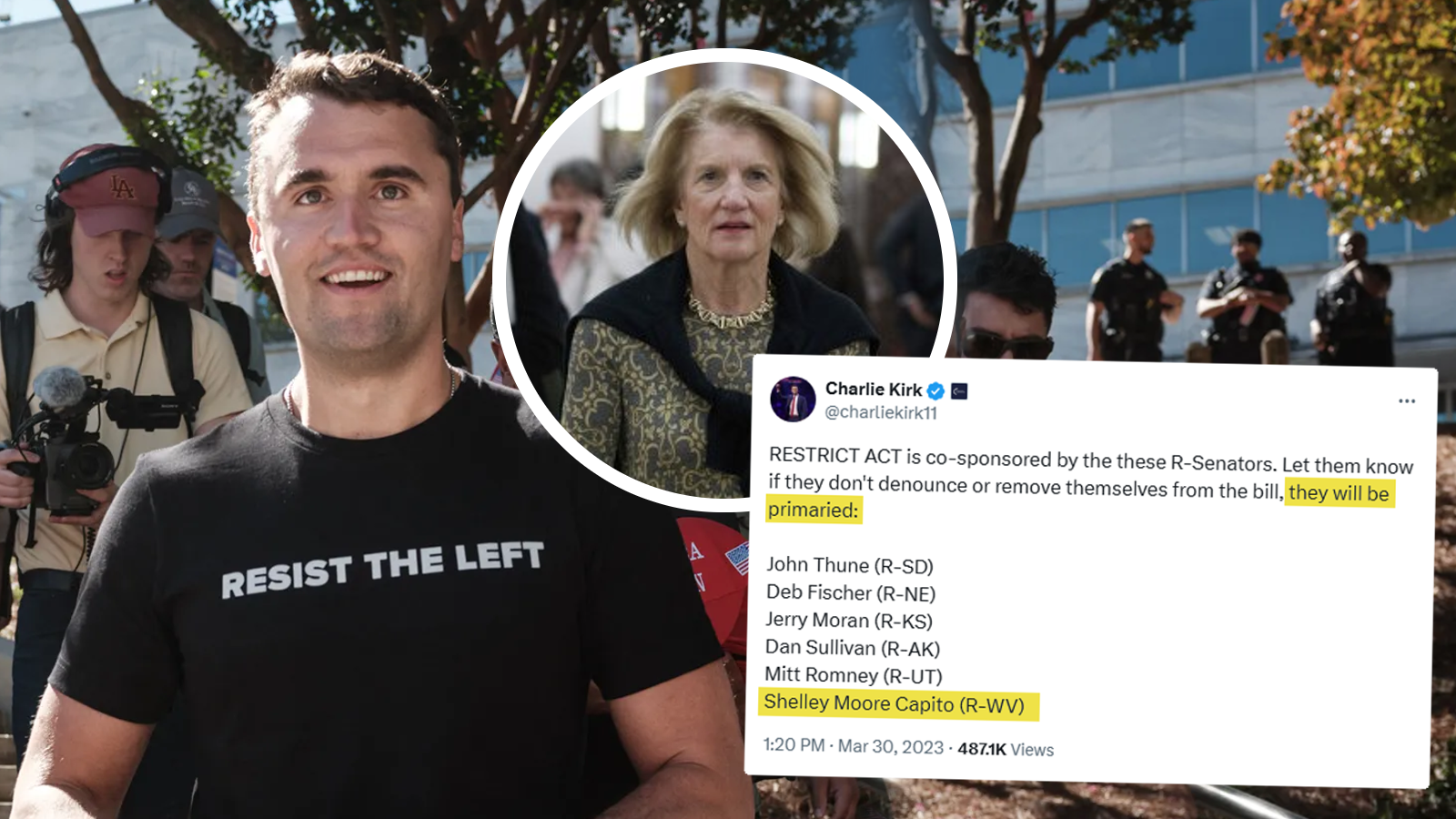
CHARLESTON — Conservative activist Charlie Kirk, who was fatally shot last September at a speaking event for Turning Point USA’s “American Comeback” tour, had earlier declared his intention to support a primary challenge against Sen. Shelley Moore Capito (R-WV) because of her co-sponsorship of the controversial RESTRICT Act.
On his March 30, 2023, show, Charlie Kirk warned that the RESTRICT Act would usher in a “brand-new censorship regime.” He said the legislation could allow the government to shut down platforms like Telegram overnight, noting that the messaging app, which has millions of active users and tends to attract a more conservative audience, “could be eliminated instantaneously.”
The legislation, known as S.686 — the Restricting the Emergence of Security Threats that Risk Information and Communications Technology Act, was introduced in 2022 and aimed to identify and mitigate foreign threats to U.S. information and communications technology, such as the social media platform TikTok.
Kirk argued that the bill’s broad powers threatened civil liberties, free speech, and internet freedom, warning that it would give the federal government sweeping authority to control or punish online activity with minimal accountability.
“The RESTRICT Act is co-sponsored by these Republican senators,” Kirk said, naming Capito among them. “Let them know if they don’t denounce or remove themselves from the bill, they will be primaried.”
The bill authorizes the Department of Commerce to monitor, investigate, and even ban online platforms or technologies deemed a “national security risk.” Critics noted that because it was introduced under President Joe Biden, it would have handed those powers to his administration, allowing unelected officials to determine what constitutes a national security threat.
Opponents warned the act could be applied far beyond foreign-owned apps, potentially targeting VPNs, privacy tools, or even domestic platforms that interact with foreign infrastructure. Kirk and other conservatives argued that the measure could grant the federal government near-total control over the internet, setting the stage for censorship and surveillance under the guise of national security.
While supporters insisted the bill was intended to safeguard Americans from foreign espionage, its vague language led critics to fear it could be interpreted to criminalize ordinary online behavior, including using restricted apps through a VPN.
The bill’s structure gives unelected bureaucrats in the Commerce Department wide discretion to define national security risks, with limited congressional or judicial oversight — a setup that opponents said could lead to decisions made “behind closed doors.”
Kirk and others have described the measure as a “Patriot Act for the Internet,” comparing it to post-9/11 laws that were designed to combat terrorism but later enabled mass surveillance of U.S. citizens.
As of now, Capito did not publicly respond to Kirk’s remarks. The West Virginia senator was among several Republicans who joined Democrats in supporting the measure, which has since stalled amid bipartisan backlash.