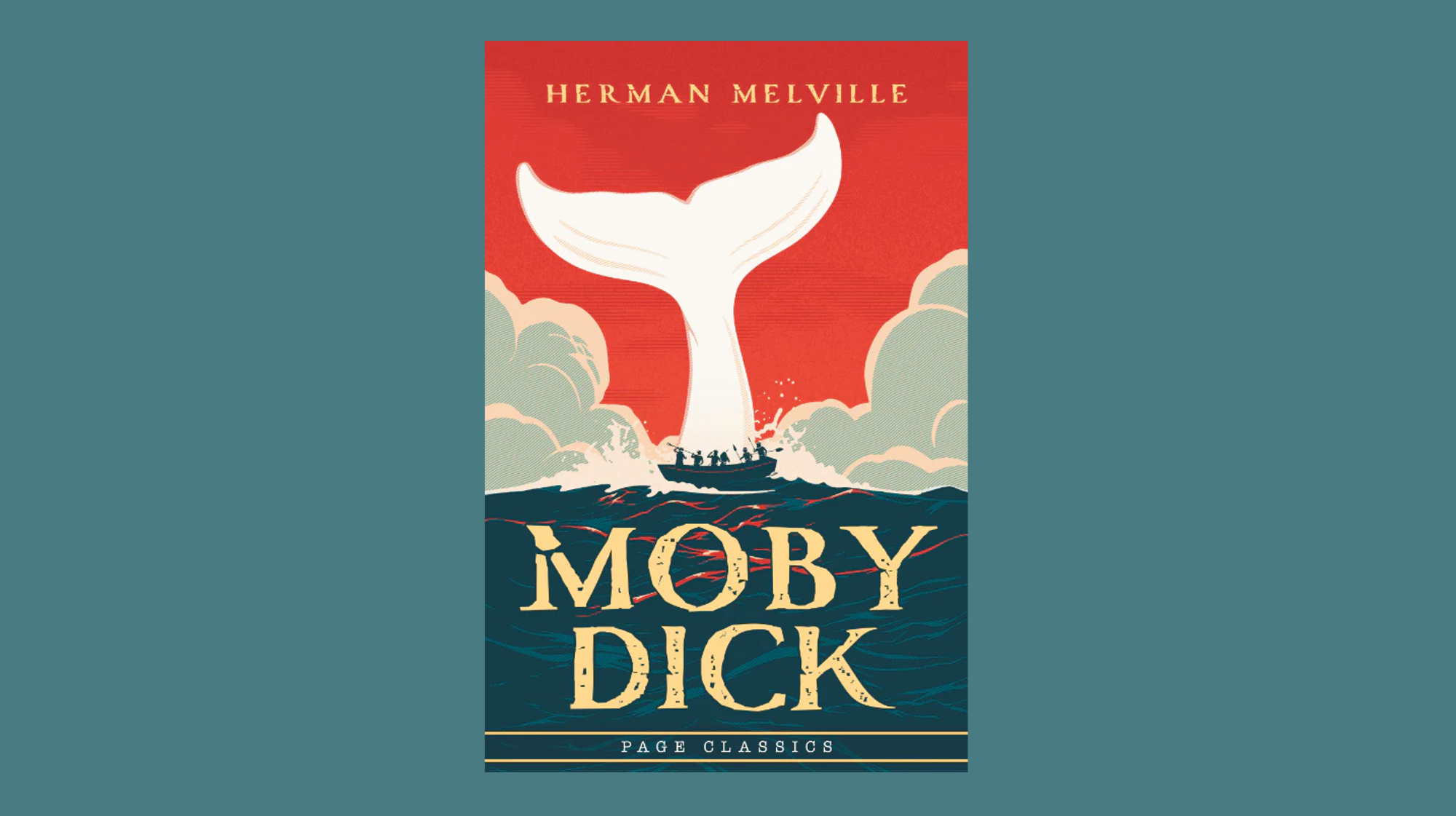

There are novels that tell a story, and there are novels that attempt to swallow the universe whole. Moby-Dick, Herman Melville’s vast, unwieldy, and fiercely strange masterpiece, belongs unapologetically to the latter. First published in 1851 to confused reviews and commercial indifference, the novel now looms over American literature like its own great whale—mysterious, intimidating, impossible to ignore.
On its surface, the book is a sea tale, chronicling the doomed voyage of the Pequod and its monomaniacal captain, Ahab, who seeks vengeance against the great white whale that took his leg. But to reduce Moby-Dick to its plot is like calling the ocean just “some water.” This is a novel obsessed not only with whales and whaling, but with the nature of obsession itself—religious, philosophical, metaphysical.
The narrator, Ishmael, begins with the famously inviting line “Call me Ishmael,” and then proceeds to lead the reader into a literary abyss that encompasses cetology, Shakespearean soliloquies, sermons, anatomy, and fate. Melville does not so much write as compose—language crashing and cresting in wave after wave of rhetorical brilliance and stormy humor. His sentences are alternately baroque and biblical, teeming with learned references and sudden violence.
Reading Moby-Dick today is to confront a nation—and a narrator—on the edge of madness. Published a decade before the Civil War, the book feels eerily prescient: obsessed with authority, driven by vengeance, haunted by the promise and peril of the American project. The Pequod is not just a ship—it is a floating microcosm of the world, peopled by a diverse crew from all corners of the earth, bound together by labor and doomed by one man’s unchecked will.
Ahab, for all his mythic stature, is less hero than force—an avatar of wrath, a prophet of ruin. And the whale? Melville refuses to give us one interpretation. Moby Dick is God, nature, capitalism, the unknowable, the sublime. The whale is everything, and nothing. It’s a symbol so heavy with meaning that it resists meaning entirely.
And yet, what makes Moby-Dick endure is not only its ambition or its philosophical weight, but its moments of quiet humanity. Ishmael’s unlikely friendship with Queequeg, the nobility of the harpooners, the strange poetry of life aboard a ship—all of it builds a world as tactile as it is allegorical. Melville may ask cosmic questions, but he never forgets the bodies asking them.
In a literary culture that often prizes economy and clarity, Moby-Dick stands proudly as a messy, magnificent contradiction. It’s a book that shouldn’t work—and for some readers, perhaps still doesn’t. But for those willing to be swept up in its tide, it offers something few novels dare: a confrontation with the infinite.
It is, in the end, not merely a book about a whale. It is a book about everything else.