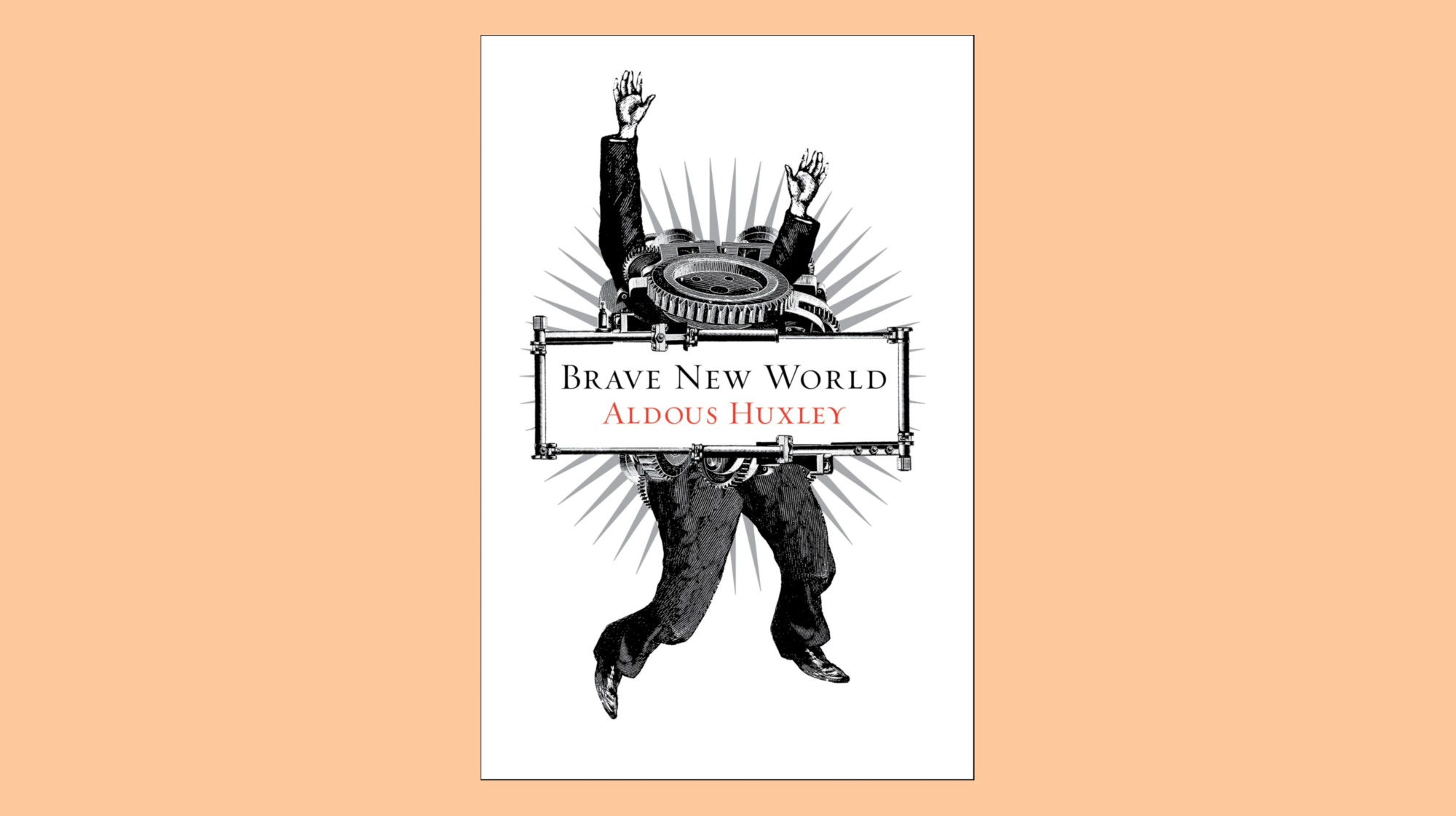
When Aldous Huxley published Brave New World in 1932, he was imagining a nightmare. Nearly a century later, his dystopia looks less like prophecy and more like a polished mirror. Where Orwell’s 1984 warned of authoritarian terror, Huxley gave us something subtler and eerily prescient: a society that doesn’t fear repression, but welcomes distraction. Pleasure, not pain, is the leash. And in that, Huxley may have come closer to predicting the 21st century than he ever intended.
The novel opens in the World State, a global regime built on the pillars of consumerism, conformity, and chemical pacification. Babies are not born but engineered, class is predetermined in the laboratory, and personal fulfillment is dosed out through a drug called soma—a cure-all for discontent. Religion has been replaced by the cult of Ford (as in Henry), love has been replaced by recreational sex, and art has been flattened into sterile entertainment. No one suffers. But no one thinks, either.
[amazon_product_button]
If the outline feels familiar, it’s because Huxley’s vision has seeped into modern life in more ways than we’re often willing to admit. The saturation of trivial content, the erosion of attention spans, the numbing effects of endless choice—these are not the side effects of our age, but its design. We carry our own soma in our pockets, scroll through curated serenity, and define progress by convenience. “Ending is better than mending,” say the citizens of Huxley’s world. Planned obsolescence could hardly ask for a clearer slogan.
But Huxley’s genius wasn’t just in the extrapolation. It was in tone. The book doesn’t thunder with outrage—it hums with unease. Written in clipped, detached prose, Brave New World lets its horror unfold quietly. There are no torture rooms, no Big Brother speeches. The nightmare is a smile, a slogan, a scientifically scheduled orgasm. It is all so clean.
The central tension of the novel comes with the arrival of John the Savage, a character raised outside the World State in a New Mexico reservation. He becomes both the conscience and the critic of the system—a man who has read Shakespeare, who believes in suffering, love, and meaning. But when brought into the “civilized” world, his ideals collapse under the weight of comfort. Huxley doesn’t offer a revolution or redemption. Only withdrawal. Only tragedy.
Today, Brave New World resonates not because it feels so distant, but because it feels dangerously plausible. When Huxley imagined a culture distracted into passivity, he couldn’t have known about TikTok or neural implants. But the trajectory he traced—from liberation to sedation—is one that modern society flirts with daily. The novel’s most chilling question remains unanswered: If a society freely chooses its own enslavement, is it still a dystopia?
It’s easy to read Brave New World as a relic of Cold War-era anxiety or a speculative foil to Orwell. But it deserves better. It is not just a cautionary tale—it is a philosophical provocation about what we value, what we relinquish for comfort, and what remains of the human spirit when all friction is removed.
In our era of curated identities and dopamine-driven decisions, Huxley’s World State no longer reads as fiction. It reads as suggestion. Which may be the most terrifying detail of all.